
Many retail investors, who are experiencing their first bear market, are shocked at the erosion in the value of their mutual fund (MF) portfolios. The pain is especially acute for those who had taken excessive exposure to sector/thematic and small-cap funds. Even international diversification has failed to stanch the bleed in this downturn.

Reliance Industries, construction major L&T and IRB Infrastructure are some of the top companies that have used an infrastructure investment trust structure to reduce part of their debt and generate returns for their investors. Earlier this month, IRB Infrastructure InvIT was listed on the National Stock Exchange, giving its investors an option to exit by selling their units. The listing came within months of the Securities and Exchange Board of India's (Sebi's) guidelines for conversion of private unlisted InvITs into listed ones were issued.

In a bid to gain a bigger share of the customer's wallet, banks are ramping up their cross-selling initiatives.

As yields on 10-year government bonds rose from 6.65% in April 2017 to around 7.50% now, liquidity pressures have increased the cost of funds for housing finance companies.

The mid-and small-cap segments at the bourses have outperformed their larger peers thus far in fiscal 2023-24 (FY24). While the S&P BSE Small-cap index has surged around 5.7 per cent in FY24, the S&P BSE Midcap index has gained 4 per cent during this period. In comparison, the S&P BSE Sensex has moved up around 2.2 per cent.

The rupee depreciated by 37 paise to close at 79.62 against the US dollar on Thursday despite sustained foreign capital inflows and a positive trend in equities. At the interbank foreign exchange market, the local currency opened at 79.22 and saw an intra-day high of 79.22 and a low of 79.94 against the American currency. It finally ended at 79.62, down 37 paise over its previous close of 79.25.

A lot of mid and small-caps are in the bubble zone and command high valuation and have corrected sharply.

Benchmark indices ended on a flat note on Thursday as fag-end selling wiped out intra-day gains amid weak global trends. The BSE benchmark Sensex slipped 8.03 points or 0.02 per cent to settle at 53,018.94. During the day, it had gained 350.57 points or 0.66 per cent to 53,377.54. Similarly, the broader NSE Nifty fell 18.85 points or 0.12 per cent to close at 15,780.25.

The sharp correction in equity markets has taken a toll on mid-and-small cap stocks that have underperformed their large-cap peers. Thus far in calendar year 2022 (CY22), the mid-and-small cap indexes on the BSE have slipped over 8 per cent and 7 per cent respectively, as compared to a fall of around 6 per cent in the S&P BSE Sensex. While investors dumped mid-and small-cap stocks as the markets remained choppy over the past few weeks, analysts still expect these two segments to see good investor interest from a medium-to-long term perspective.

Investors' wealth on Thursday tumbled over Rs 2.81 lakh crore as stocks declined in line with selloff in global equities. The 30-share BSE benchmark index tanked 581.21 points or 1 per cent to settle at 57,276.94. During the day, it cracked 1,418.79 points to 56,439.36. In tandem with weak trend in equities, the market capitalisation of BSE-listed firms tanked Rs 2,81,147.38 crore to Rs 2,59,97,419.48 crore.

The derivatives expiry on Thursday is also expected to add to the volatility.

Undeterred by the stock market volatility, uncertainty due to the Ukraine-Russia war and high inflation, equity mutual funds continue to remain attractive choice for investors for the 15th straight month, registering a net inflow of Rs 18,529 crore in May on robust SIP numbers. This was higher than Rs 15,890 crore net inflow in April, data from the Association of Mutual Funds in India (AMFI) showed on Thursday. Equity schemes have been witnessing net inflow since March 2021, highlighting the positive sentiment among investors.

Fundraising activity in the upcoming financial year 2022-23 may even surpass FY22 when 52 Indian companies raised a record Rs 1.11 trillion via initial public offerings (IPOs). According to a note by PRIME Database, 54 companies (including LIC) plan to raise Rs 1.4 trillion and currently hold the Securities and Exchange Board of India's (Sebi's) approval. Another 43 companies, the note said, are looking to raise about Rs 81,000 crore but waiting for Sebi nod.

Investors' wealth has jumped Rs 9,57,201.52 crore in the last three days of rally in equity market as stocks continued to march higher amid the Budget-led euphoria. The 30-share BSE benchmark on Wednesday zoomed 695.76 points or 1.18 per cent to settle at 59,558.33 as the post-Budget rally continued. This is the third day of rally in equities and helped by the optimism, the market capitalisation of BSE-listed companies jumped Rs 9,57,201.52 crore to Rs 2,70,64,905.75 crore in three days.

Quarterly earnings from IT majors Infosys and Wipro, macroeconomic data announcements and global cues would be the major drivers for the equity markets this week, said analysts. Leading IT companies Infosys and Wipro and other players such as Mindtree, Tata Elxsi and HDFC AMC would announce their financial results this week. Moreover, industrial production numbers, retail and wholesale inflation data would be released this week.
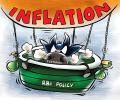
The RBI's Monetary Policy Committee brainstormed the impact of any future shocks on the inflation trajectory and stressed monitoring the cumulative effect of monetary policy actions over the past one year, which is still unfolding, revealed minutes of the rate-setting panel released on Thursday. The minutes of the meeting of the Monetary Policy Committee (MPC), headed by Reserve Bank Governor Shaktikanta Das, also indicated it would be premature to declare an end to the monetary tightening cycle, which started in May 2022 to check high inflation following the outbreak of the Russia-Ukraine war. The central bank, which effected six back-to-back hikes in the key short-term lending rate (repo) since May 2022 to check high inflation, decided to take a pause early this month.

Markets this week would be guided by the ongoing quarterly earnings, macroeconomic data announcement and global trends, analysts said. The government will release industrial production data for June and inflation data for July this week. The RBI has revised its retail inflation forecast to 5.7 per cent, up from the earlier 5.1 per cent due to price pressure on account of supply constraints and high crude oil prices.

Investors continue to back-up equity mutual funds in June as such schemes attracted a net inflow of Rs 15,498 crore on strong flows from systematic investment plans despite volatility in the stock market and relentless selling by Foreign Portfolio Investors (FPIs). This also marked the 16th straight month of positive inflow in equity schemes. Inflows into equity mutual funds in June was lower compared to the net inflow of Rs 18,529 crore seen in May, data from the Association of Mutual Funds in India (AMFI) showed on Friday.

This is the Mukesh Ambani-led company's second entry into the dairy segment and it will directly compete with Amul and Mother Dairy.

Benchmark indices failed to hold on to early gains and closed in the red for the seventh straight session on Thursday, with participants remaining in wait-and-watch mode ahead of the RBI's interest rate decision. Unabated selling by foreign funds added to the pressure, though a modest recovery in the rupee cushioned the fall, traders said. After rallying in early trade, the 30-share BSE Sensex came under selling pressure in the afternoon session and closed 188.32 points or 0.33 per cent lower at 56,409.96.

Voice calling will be free on Jio phones for life and post December 31, 10 data plans will be offered

Equity markets extended their rally on Friday, with the Sensex and Nifty jumping over 1 per cent each, in tandem with a positive trend in global equities. Buying in Infosys and banking counters helped markets maintain their winning run. The 30-share BSE Sensex rallied 632.13 points or 1.17 per cent to settle at 54,884.66.

After the easing of lockdown in mid-May, auto companies were able to resume production in a phased manner, but the ramp-up was slow due to a broken supply chain, and lockdown-induced restrictions.

After a stellar run that saw the frontline indices - the S&P BSE Sensex and the Nifty 50 - clock gains of around 21 per cent and 24 per cent respectively in calendar year 2021 (CY21), the year gone by in real sense belonged to the mid-and small-cap segments. Thus far in CY21, the mid-and small-cap indexes on the BSE have far outpaced the run in the frontline indices and notched up a gain of around 38 per cent and 61 per cent, respectively during this period. Though analysts expect the outperformance to continue in 2022, they caution against the multiple headwinds in the year ahead that may dent the overall market sentiment.

Equity investors became poorer by over Rs 9.75 lakh crore in two days of heavy decline in the equity market, with the Sensex plunging 1,457 points on Monday. The 30-share BSE benchmark tanked 1,456.74 points or 2.68 per cent to settle at 52,846.70 on Monday. It had ended 1,016.84 points or 1.84 per cent lower at 54,303.44 on Friday.

'As China's reopening euphoria fizzled out on the back of some disappointing economic data, we saw inflows coming back to India with full force in the past 3-4 months.'

Equity investors became poorer by over Rs 6.71 lakh crore on Thursday as domestic benchmark indices tumbled amid a global market meltdown. The 30-share BSE benchmark Sensex tanked 1,416.30 points or 2.61 per cent to settle at 52,792.23, tracking weak global markets and persistent foreign fund outflows. In line with the weak market trend, the market capitalisation of BSE-listed firms tumbled by Rs 6,71,051.73 crore to stand at Rs 2,49,06,394.08 crore.

India will need $223 billion of investment to meet its goal of wind and solar capacity installations by 2030, according to a new report by research company BloombergNEF (BNEF). The government has set a target of increasing non-fossil power capacity to 500 GW by 2030. It wants non-fossil fuel power sources to provide half of its electricity supply by 2030. "To achieve this target, India needs to massively scale up funding for renewables," the report said, adding that $223 billion is required over the next eight years just to meet the solar and wind capacity targets.

After turning net buyers last month, foreign investors have become aggressive shoppers of Indian equities and have invested Rs 22,452 crore in the first two weeks of August amid softening inflation concerns. This was way higher than a net investment of nearly Rs 5,000 crore by Foreign Portfolio Investors (FPIs) in the entire month of July, data with depositories showed. FPIs had turned net buyers for the first time in July, after nine straight months of massive net outflows, which started in October last year.

Reliance Industries Limited on Wednesday became the first Indian company to hit the Rs 19 lakh crore market valuation mark following a rally in its share price. The market heavyweight stock jumped 1.85 per cent to its record high of Rs 2,827.10 on the BSE. Following the gain in the share price, the company's market valuation jumped to Rs 19,12,814 crore in morning trade on the BSE.
Foreign portfolio investors (FPIs) pulled out as much as Rs 17,537 crore from the Indian markets in just three trading sessions of March as investors' sentiment got dented by the uncertainty triggered by the Russia-Ukraine conflict and rising crude oil prices. As per depositories data, they pulled out Rs 14,721 crore from equities, Rs 2,808 crore from debt segment and Rs 9 crore from hybrid instruments between March 2-4. This took the total net outflow to Rs 17,537 crore.

What worked for the markets was favourable global investor sentiment and encouraging flows into the emerging markets following stimulus measures taken by central banks.

The rally in silver may continue if the global economic recovery remains on course.

Domestic mutual funds (MFs) have kept their faith in the Indian stock market despite multiple headwinds all through 2022-23 (FY23), with their net flows into equities crossing the Rs 1.5-trillion mark for the second consecutive financial year. MFs pumped a net Rs 1.53 trillion into equities till March 1, 2023, the Securities and Exchange Board of India (Sebi) data shows, as compared to Rs 1.72 trillion in FY22. Since FY15, MFs have been net buyers of equities, except in FY21, when they sold a net Rs 1.21 trillion.

Around 75 per cent, or 372 stocks, that are part of the BSE500 are trading at least 10 per cent below their all-time high levels, despite the index hitting a record high 20,515 points on the BSE in intra-day trade on Wednesday, surpassing its previous high of 20,390 touched in March 12. The index, which accounts for 93 per cent of BSE listed companies' market capitalisation, has gained 8 per cent from its recent low of 18,983, touched on April 19. In comparison, the benchmark S&P BSE Sensex gained 6 per cent over the same period, but is still nearly 4.5 per cent away from its all-time high of 52,517 that it hit on February 16.

Foreign portfolio investors (FPIs) have pulled out Rs 17,696 crore from the Indian markets in December so far amid uncertainty due to a new coronavirus strain, Omicron, and expectations of faster tapering by the US Federal Reserve. According to the depositories data, FPIs took out Rs 13,470 crore from equities, Rs 4,066 crore from the debt segment and Rs 160 crore from hybrid instruments between December 1-17. In November, FPIs were net sellers to the tune of Rs 2,521 crore in Indian markets.

An expert committee appointed by the Supreme Court said it cannot conclude any regulatory failure around Adani Group's stock rallies, and that Securities and Exchange Board of India (SEBI) has 'drawn a blank' in its probe into alleged violations in money flows from offshore entities into the conglomerate.

An expert committee appointed by the Supreme Court said it cannot conclude any regulatory failure around Adani Group's stock rallies, and that Sebi has "drawn a blank" in its probe into alleged violations in money flows from offshore entities into the conglomerate. But the six-member panel said there was an evidence of a build-up in short positions on Adani Group stocks ahead of the report of US-based short seller Hindenburg Research, and profiting from squaring off positions after prices crashed post-publication of the damning allegations. "At this stage, taking into account the explanations provided by Sebi, supported by empirical data, prima facie, it would not be possible for the committee to conclude that there has been a regulatory failure around the allegation of price manipulation," the panel said in the report submitted to the Supreme Court.

Rebalance your portfolio in case it has become overweight on equities vis-a-vis your strategic asset allocation.

An improvement in political relations, anchored in a restoration of peace and tranquillity at the border, could open up opportunities for expanded economic and commercial relations between them, suggests former foreign secretary Ambassador Shyam Saran.
 © 2026 Rediff.com - Advertise with us - Disclaimer - Privacy Policy - Sitemap - Feedback - About us - Terms of use - Grievances